
Good morning and welcome back to the breakroom, I hope you have all had a great week. I also hope that you have all come eager and prepared because it is Performance Review day here at the office, so mentally fortify yourself for some severe scrutiny.
If anyone is all about fortification, it is Dwight who is showing off his brand new “fitness orb” which he is using in lieu of an office chair. According to him, there are numerous health benefits such as providing an intense ab workout. This practice is nothing new and you can still find fitness balls meant for use as a chair today (while some use just the ball, there are special mounts which help prevent the ball from slipping unintentionally). But while there are numerous articles backing the use of balls for working out or for temporary purposes like pregnancy, the main source I found for use as an office hair replacement was negative. In an article by Elizabeth Chang from The Washing Post, studies have been conducted which find their use as chairs is mostly hype. As chairs they are found to be uncomfortable, can lead to “spinal shrinkage,” and in terms of burning calories only amounts to roughly an additional four calories per hour of use compared to a normal chair1. These are certainly beneficial to use while working out but they do not seem to be beneficial enough to use for such long periods of time, unfortunately. Certainly to each their own and it never hurts to talk to a medical specialist or do more research. While I have only ever seen one of these in an office myself, the biggest thing nowadays are standing desks. This is where the desk raises up and you then roll your chair away and stand. Additionally, there are desks connected to treadmills but these might be best for working from home. Myself, I do have an under-the-desk cycling machine that I try to use (when I remember) to get my legs moving a bit. Regardless, I think it is good that we who are tied to desks are trying to get creative in getting some exercise and movement in during the day and it doesn’t hurt to try different ideas until they work out. Additionally, Jim does show us that the balls do have one major flaw in that they are easily popped with a pair of scissors, so please watch out for pointy objects.
With Dwight back in his normal chair, I think we can now carry on the performance reviews! So what are performance reviews, you might be asking yourself? A performance review is typically a formalized assessment of an employee. Traditionally these are scheduled, most companies will do these once a year (like Dunder Mifflin) and are meant to evaluate the strengths and weaknesses of an employee, offer some constructive feedback, and can even offer a chance for development or goal setting for the employee. Additionally, a big piece of them for many companies is these can impact your annual increase. I had a couple of positions where the review was set up as a scorecard which was completed by my manager where their rating offered a “point” which when tallied all together would produce a score which would tell me what percent increase I would receive. More recently, I see that our annual increases are separate from such tools and the performance review has a greater emphasis on being an employee-led conversation. While my leader will provide assessments on my skills, one of my responsibilities is to choose a topic that I want to include with the conversation. Some examples can include talking about my strengths, my personal well-being, unique roadblocks I could use solutions to, and career development. We also refer to these as Development Conversations, so the emphasis is meant to be placed on focusing to the future rather than criticizing the past and I do believe is has shown to be more beneficial than the one-sided reviews from leaders I have had in the past. Additionally, I believe a lack of the “annual review” is also related to the fact that I have monthly one-on-one sessions with my leader which can act as a replacement to discuss how work is progressing and it can be discussed if there any issues. How a company operates is certainly at the discretion of the senior leaders, but I can say that the “annual review” is no longer the standard tool and is being replaced by far more efficient assessment methods and I would agree than doing such a review only once a year is not ideal.
Now, not only does Dunder Mifflin still prefer to do annual performance reviews, Michael seems to have a very loose grasp on what is meant to be included in the review. Pam was called in to go through hers among the first, and if you know Michael than it went about as expected. He started off by commenting on her as being trustful, as well as a woman. Evidently Michael is attempting to use the reviews as a chance to get everyone’s opinion on a message left by Jan. Certainly inappropriate, but not necessarily the worst opportunity since Pam was quick to lean in on the topic to garner a better review. I mean, if you are going to have an unorthodox review you might as well use it to your advantage, right? For the record, my personal interpretation of the message was she really was simply coming to work to discuss the reviews and Michael was the only one who felt their moment together meant more than it was. But if telling Michael what he wants to hear gets me a raise, I’m willing to say Michael is absolutely barking up the right tree. Of course, neither Pam nor I were as prepared for this moment as Stanley. I have never seen anyone so invested in a conversation with Michael before, but he went in there motivated to work the conversation over for that bonus. I know Angela, on the other hand, actually appreciates the act of being judged and criticized but she couldn’t even make it to Michael’s door. She got a “quite satisfactory” and Michael rushed away for some phone call with Jan; frankly this is still one of the better reviews that happened today.
With Jan coming in today, Michael seemed eager about setting the right tone to show off a bit. I heard him asking Pam about an “ideas book” he seemed to think she kept for his unique thoughts and ideas. For those who often have interesting ideas, by all means carry around a notebook and pen around with you. While nearly all of us have phones, I feel the act of taking the time to write down an idea on paper offers a greater level of motivation behind following through. It wasn’t until I started to jot down my ideas about this blog that it finally became reality. I actually have multiple notebooks for different types of ideas; I’m a fan of the Field Notes because they’re small and simple, but any notebook will do. But since Pam hasn’t been keeping track of these ideas for Michael, he is going to settle for the suggestion box. Now, this box hasn’t been used since before I even started so he will need to rally the office if he hopes to get a set of suggestions in time to showcase this to Jan.
Much like “performance reviews” physical suggestion boxes are slowly disappearing. These are meant for individuals to offer anonymous suggestions to the reader; traditionally these are seen in businesses for customers to submit ideas, but these can be used as a means for employees to voice their ideas as well. What is more common with larger companies nowadays are periodic surveys which typically have specific questions for employees to answer, but then a section for specific comments. For example, a common question would be “Would you recommend this company as a place to work to a friend or family member?” The answer format will normally be either Yes/No, or a scale rating of Least Favorable to Most Favorable. This would then be followed by a section to include notes such as why you might not recommend, or perhaps giving a confirmation that you already have. Regardless of the format, it is beneficial for companies to have anonymous means for employees to voice ideas and concerns because it is often difficult for an employee to raise serious questions due to the concern of retaliation. All too often, large companies just expect their staff to come to work with no problem and to look past any problems they might be having. In reality, employees can have very serious concerns that are threatening their willingness to remain with the company and they deserve the opportunity to voice these concerns in an attempt to have them rectified. To be honest, I think most companies are like Michael and simply looking for “constructive compliments” for the employees than any sort of suggestions.
Much like the performance reviews, I do not think we should be truly surprised by how the suggestion box meeting went. Michael had all these hopes for brilliant suggestions to fix; since these are all meant to be anonymous, he truly could have made up ideas but instead was confident his staff would have his back. Instead, the suggestions we got were:
“What should we do to prepare for Y2K?” Evidently this was stuck in the box and is simply old.
“We need better outreach for employees fighting depression.” No longer needed since this was written by our colleague Tom, who unfortunately committed suicide.
“You need to do something about your B.O.” Per Michael, Creed is much smellier.
“You need to do something about your coffee breath.” A win, Michael said he will work on that.
A piece of gum inside paper. Simply put.
“Don’t sleep with your boss.” Unfortunately, this brought the meeting to a close.
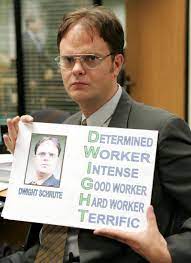
So this meeting was fun while it lasted, but it did open up the afternoon for Dwight to prepare for his own performance review. If you want to prepare for a review, you need to take a page out of Dwight’s book. He first amped himself with music before the meeting to put himself in the right headspace. He also came in with an entire presentation for the review including making his name into an anagram, charts to show that he has never missed a day and even shows up on holidays, and had an entire speech prepared to explain why he deserves a great review and a raise. While he went above and beyond, he does use several tools that you should consider for your own next evaluation of your work. Music is a great means to getting into the right space, use a song that pumps you up and makes you feel confident. Put together a list of specific instances where you were a great employee or focus on specific strengths that set you apart from your colleagues. Especially if raises are on the line, then feel free to make up a chart or two if you would like some visual flair to emphasize how invaluable you are. Be confident and work for what you are worth, or as Stanley would say “it’s all about my bonus.”
And like, you made it through your first performance review with Dunder Mifflin. If you can walk away learning anything, I think the most important pieces would be to voice your concerns so large companies can be held accountable; and second, work the system to get what you are worth. Until next time, I will see you around the breakroom!
Do you have your own methods of preparing for a big review or evaluation, leave a comment so we can try out your technique!
- Chang, E. (2020, September 29). You might want to rethink using a stability ball as your desk chair. The Washington Post. Retrieved November 22, 2023, from https://www.washingtonpost.com/lifestyle/wellness/stability-ball-balance-core-calories/2020/09/29/0b485c74-feb4-11ea-9ceb-061d646d9c67_story.html ↩︎
